

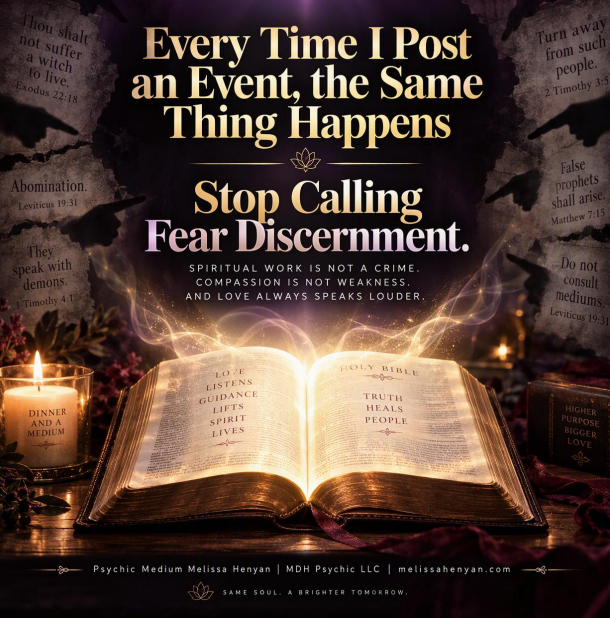
Every time I post an event, the same thing happens: Bible verses appear as warnings, verdicts, and threats. Rarely questions. Rarely curiosity. Just condemnation from people who have never attended my work, spoken with the people I have helped, or examined the history behind the words they quote. Before anyone calls this work evil, they should understand what it actually looks like: sitting beside people in crushing grief, helping them feel less alone, and offering a moment of peace when their lives have been shattered. I am done accepting fear as truth.
This Is Not an Attack on Religion
This is not about every Christian, every church, or every community. It is about a specific pattern: people using religion not simply as a belief, but as a weapon against work they have already decided to fear. Faith deserves respect. So do facts, context, conscience, and the people being condemned.
I am exhausted by Bible-based fearmongering being thrown at me. I am not anti-religion, and I am not trying to take anyone’s faith away. I am saying: know the whole text. Know its history. Know what was translated, what is debated, and what has been conveniently ignored. If you bring scripture into this conversation, bring the whole conversation, not only the verses you can use against someone else.
Why This Work Threatens Certain Religious Systems
When I host Dinner and a Medium, I connect people with their loved ones in Spirit. I am not telling anyone what to believe. I am creating space for people to receive messages, recognition, and comfort through what I understand as communication with Spirit, the soul’s Divine Spark of Consciousness. That threatens systems built on the claim that spiritual authority must pass through an approved leader, doctrine, or institution. A person who trusts their own experience and discernment is harder to frighten and harder to control.
Know the Words You Are Quoting
People keep throwing Leviticus and Deuteronomy at me as though quoting a verse ends the discussion. It does not. If you are going to use scripture to condemn someone, you should know what its words meant, the world they came from, and the argument required to apply them now.
The Hebrew terms are ancient, and they are not as simple as the single English word medium.
- ʾōḇ: (pronounced ohv, like stove) Can refer to a spirit associated with the dead, a means of consulting such a spirit, or a practitioner connected with it. Older English versions often used "familiar spirit," while many modern versions use "medium." That translation does not give anyone permission to collapse every modern intuitive practice into one ancient category.
- yiddeʿonim: Pronounced approximately "yid-deh-oh-NEEM," translated in different Bibles as "spiritists," "wizards," "soothsayers," or "mediums." The language points to ancient forms of forbidden spirit consultation and divination. It does not provide a modern job description for me.
Ancient divination appeared in personal life, royal courts, warfare, healing, and attempts to gain hidden knowledge. I will not distort that history by pretending the terms meant only political sorcerers. But neither will I accept the opposite distortion: that one ancient label automatically defines every person today who uses intuition, offers spiritual counsel, or claims communication with the dead.
If you believe my work violates your theology, make the case honestly. Show the linguistic evidence. Acknowledge the historical setting. Explain how you are moving from an ancient prohibition to my actual practice. You do not get to skip all of that, point at an English label, and call the judgment complete.
What Was Happening When This Prohibition Entered the Biblical Text?
These laws come from ancient Israel, where divination was part of a wider Near Eastern world of household religion, royal courts, warfare, healing, and attempts to obtain hidden knowledge. Biblical law draws boundaries around acceptable and unacceptable sources of revelation. That setting helps explain the prohibition, but it does not prove that politics or military strategy was the purpose in every case.
We also need to understand what was at stake when these prohibitions were written. In the ancient Near East, divination was not merely a private spiritual practice. Kings and courts consulted omens, diviners, prophets, and the dead before wars, political decisions, and questions of succession. Deuteronomy does not simply ban one spiritual technique. It rejects competing sources of revelation and directs the people toward an authorized prophet. Israel still accepted dreams, visions, prophecy, sacred lots, and other forms of divine guidance when they came through approved channels. So the dividing line was never simply supernatural communication versus no supernatural communication. It was authorized revelation versus unauthorized revelation. In other words: who was allowed to speak for God, whose message could influence the people, and who controlled access to spiritual authority?
That does not prove the law was invented only for political control, and I will not pretend the religious conviction behind it was fake. It does show that religion, government, warfare, and spiritual authority were intertwined. When someone removes the prohibition from that world and applies the English word “medium” directly to my grief-centered work today, they erase the very history they claim gives the verse authority.
No single identifiable person simply inserted the word medium into the Bible. The underlying Hebrew is ancient, and the English label is a translation choice. The 1611 King James Version commonly rendered the phrase as "familiar spirit." Later translations, produced by committees rather than one translator, often used "medium" because it was more intelligible to modern readers. Translation is interpretation, but variation in wording is not by itself evidence of a conspiracy or deliberate corruption.
We also need to stop treating James as a neutral spiritual figure. In Daemonologie, he repeated the belief that women were weaker and more easily ensnared by the Devil. He involved himself in witch investigations and used royal authority to strengthen a culture of persecution in which women were overwhelmingly the accused and executed. That history matters when people hold up the Bible bearing his name as though neither power, misogyny, nor political control had anything to do with the world that produced it.
The honest conclusion is not that these verses say nothing about spirit consultation. They do. The honest conclusion is that applying them to every form of modern intuition, grief work, spiritual counseling, or mediumship requires an argument. The English word alone does not do the work for you. Context is not an excuse. It is the minimum standard for anyone claiming the authority to condemn another person.
Key Passages Examined
The passages below are the texts most often used to condemn mediumship, and I have identified whether each comes from the Old Testament or the New Testament. That distinction matters because one common response is, “Those laws are from the Old Testament, so Christians no longer follow them.” Exactly. That response proves interpretation is already happening. People decide that some commands belonged to a particular covenant, culture, or historical setting, while treating other passages as timeless when they want to condemn someone else. I am not avoiding these texts or pretending they say nothing about spirit consultation. I am examining what they actually say, the settings in which they appear, and the assumptions required to apply them to modern mediumship, grief work, or spiritual counseling.
- Leviticus 19:31 (Old Testament): Prohibits turning to ʾōḇ practitioners and yiddeʿonim. It clearly rejects those ancient practices. What remains debated is how closely either term corresponds to modern categories.
- Deuteronomy 18:10–12 (Old Testament): Lists several forbidden practices, including divination, sorcery, consulting an ʾōḇ, and seeking information from the dead. Its concern is broader than one technique and contrasts these practices with prophetic authority in Deuteronomy 18:15–22.
- 1 Samuel 28 (Old Testament): Saul consults the woman at Endor during a military crisis. The narrative links the episode to Saul's desperation and disobedience. Interpreters disagree over what precisely the story implies about the practice itself.
- Leviticus 20:6 and 20:27 (Old Testament): Intensify the prohibition with warnings and a death penalty for mediums and spiritists. If someone wants to lift these texts straight into the present, they also have to explain what they are doing with the penalty, the covenant setting, and the ancient legal world that produced it.
- Isaiah 8:19 and 19:3 (Old Testament): Challenge people who consult the dead instead of God, naming mediums in a setting of national fear and failed counsel. These passages are about where terrified people seek control, not a blank check to condemn every grief centered practice without examination.
- 2 Kings 21:6 and 23:24 (Old Testament): Manasseh is condemned for divination and consulting mediums; Josiah later removes these practices from Judah. These are royal, covenant-reform texts showing that the Bible condemns certain practices, but they do not prove that every modern person offering spiritual counsel is doing the same thing Manasseh did.
- 1 Chronicles 10:13–14 (Old Testament): Saul's death is interpreted as unfaithfulness for consulting a medium and failing to inquire of the Lord. The issue is Saul's desperation and refusal to seek God properly. Critics citing Saul must cite the whole context.
- Acts 16:16–18 (New Testament): Paul commands a spirit of divination to leave a slave girl, exposing the economic exploitation of her condition. Exploitation and control are part of the story.
- Acts 19:18–19 and Galatians 5:19–21 (New Testament): Describe people renouncing magical practices and list sorcery among works of the flesh. Put those on the table too, but do not use them lazily. Define the practice and name the harm.
- Matthew 17:1–8, Mark 9:2–8, and Luke 9:28–36 (New Testament): Jesus speaks with Moses and Elijah at the Transfiguration. The Gospels frame this as divine revelation, destroying the lazy claim that any encounter across the boundary of death is automatically demonic. Source matters. Purpose matters. Context matters.
Jesus spoke with Moses and Elijah at the Transfiguration. Moses was dead, yet he appeared and communicated with Jesus. Christians call the encounter divine revelation because it came through God rather than sorcery or an attempt to control the dead. But that is exactly the distinction I have been asking people to make. Communication across the boundary of death is not automatically necromancy, demonic activity, or evil. If the source is God, the purpose is meaningful, and no one is being manipulated, exploited, or harmed, then the act cannot be condemned by the label alone. Call it revelation if that word feels safer. Functionally, it is communication between the living and the dead. That, my friend, is mediumship.
If We Quote Scripture, We Must Face Its Difficult Texts
Some troubling passages are mistranslated or stripped of context. Others genuinely preserve ancient hierarchies and violence. Context can explain how a text arose; it should not be used to deny what the text says or dismiss the people harmed by its interpretation.
- Deuteronomy 22:28–29 (Old Testament), a raped unmarried woman forced into marriage: Many translations describe a man seizing and raping an unbetrothed virgin; others render the encounter less explicitly, so scholars debate the precise legal category. What is not debated is that the law centers the father’s financial loss, requires the rapist to pay him fifty shekels, and binds the woman to a marriage the man can never dissolve. In an ancient world where her economic survival was tied to a household and her marriage prospects, this may have been presented as protection from destitution. It still makes her future dependent on the man who raped her. Historical context explains the system. It does not make that outcome humane.
- Leviticus 12:2–8 (Old Testament), a mother treated as ritually unclean after childbirth: After giving birth to a son, a woman is assigned seven days of impurity and another thirty-three days before she may touch sacred things. After giving birth to a daughter, those periods double to fourteen and sixty-six days. “Unclean” is a ritual category, not a claim that the mother committed a sin. But the text still bars her from sacred contact because she gave birth, and it imposes a longer exclusion when the child is female. We can explain the ancient purity system without pretending the inequality is not there.
- Deuteronomy 21:18–21 (Old Testament), a rebellious son sentenced to death: This is not about a small child talking back. The son is described as persistently defiant, a glutton, and a drunkard. Both parents bring him before the town elders, and the men of the town stone him to death. Later Jewish interpretation narrowed the law so severely that some rabbis said it had never happened and never would. That later restraint matters. It does not erase the written sentence: the community kills the son.
- 1 Corinthians 14:34–35 (New Testament), women ordered to be silent: These verses tell women to remain silent in the assemblies and take their questions home to their husbands. First Corinthians 11 assumes women pray and prophesy, and scholars debate whether chapter 14 addresses disruptive speech, a local conflict, or a later insertion. That debate deserves honesty. So does the damage: these words have been used for centuries to shut women out of pulpits, leadership, education, and public authority.
- Deuteronomy 25:5–10 (Old Testament), a widow’s future assigned to her dead husband’s brother: A childless widow is expected to marry her deceased husband’s brother so the dead man’s name and inheritance continue. In a society where a widow’s survival often depended on male kin, the arrangement could provide economic security. It also organizes her body, sexuality, and future around producing an heir for a dead man. The brother may refuse and be publicly shamed. The text does not give the widow the same clearly stated choice.
- Leviticus 15:19–30 (Old Testament), menstruation treated as contaminating: The text assigns menstruation a seven-day period of ritual impurity. People who touch the woman, her bed, or objects on which she sits become ritually unclean until washing and evening. It does not explicitly command every menstruating woman to live in solitary confinement, and ritual impurity is not the same as moral guilt. But the bodily function is still treated as something that transfers impurity, and later communities have used these rules to shame, isolate, and control women.
- Leviticus 19:19 and Deuteronomy 22:11 (Old Testament), clothing made from mixed materials forbidden: Leviticus prohibits a garment made from two kinds of material, while Deuteronomy specifically names wool and linen together. So “your cotton-poly blend is forbidden” is not a precise quotation. The stronger point does not need a joke: biblical law contains symbolic boundary rules about fabric mixtures that most modern Christians do not enforce, even while insisting that other ancient rules must be applied literally to someone else.
- Leviticus 11:9–12 (Old Testament), shellfish declared detestable: Water creatures without fins and scales, including shrimp, crab, lobster, and clams, are prohibited and described as detestable within Israel’s dietary system. Most Christians no longer obey that prohibition because later theology changed how they understand covenant and food laws. That is interpretation. People do not get to practice interpretation at dinner and then deny that interpretation exists when they want a verse to condemn another person.
- Leviticus 19:28 (Old Testament), bodily cutting and markings forbidden: The verse prohibits cutting the flesh for the dead and placing a mark on the body. Scholars debate the exact practice and whether it corresponds to modern tattooing. The verse may concern mourning rites, ritual identity, or both. What it does not support is the smug certainty of quoting “no tattoos” while erasing the setting and acting as though an English word settles an ancient question.
- Exodus 31:14–15 and Numbers 15:32–36 (Old Testament), Sabbath work punished by death: Within Israel’s covenant law, profaning the Sabbath carries a death sentence. Numbers does not leave that sentence theoretical: a man gathering wood is taken outside the camp and stoned to death. Most people who weaponize biblical penalties against others are not demanding the execution of everyone who works on Saturday. They have already decided this death penalty does not apply. That is interpretation, whether they admit it or not.
- Deuteronomy 22:13–21 (Old Testament), a bride stoned over her virginity: A husband accuses his new wife of not being a virgin. If her family produces the required evidence, he is punished and may never divorce her. If the accusation is upheld, she is taken to the entrance of her father’s house and stoned to death by the men of the town. This is an honor-based, patriarchal system in which a woman’s sexuality is treated as evidence belonging to her father’s household and her husband’s rights. The safeguards do not make the punishment less brutal.
- Exodus 21:2–11 and Leviticus 25:44–46 (Old Testament), human beings owned as property: These texts regulate slavery. They do not abolish it. Israelite debt servants receive some protections and possible release, while Leviticus permits foreigners to be purchased, owned, inherited, and passed to children as permanent property. Exodus 21 discusses a father selling his daughter under a gendered household arrangement. Ancient slavery was not identical in every respect to modern racialized chattel slavery. That distinction must not become an escape hatch. These laws still permit ownership, coercion, sale, and inherited control of human beings.
- Leviticus 24:19–20 (Old Testament), bodily injury answered with bodily injury: “Fracture for fracture, eye for eye, tooth for tooth” establishes proportional punishment so retaliation does not exceed the original injury. Later Jewish law generally applied financial compensation rather than literal mutilation. That legal development matters. It also proves that communities interpreted the text rather than merely repeating its bodily violence as though no moral reasoning were required.
- Leviticus 19:19 (Old Testament), mixed seed forbidden: The law prohibits sowing a field with two kinds of seed. It reflects an ancient concern with keeping created categories separate. Most modern believers do not inspect gardens for mixed planting or call the gardener sinful. They interpret the command as culturally or covenantally limited. Again, interpretation is already happening. The only question is whether it is applied honestly and consistently.
- Deuteronomy 17:2–7 (Old Testament), worshiping another god punished by stoning: An Israelite convicted of worshiping other gods is to be taken outside the city gates and stoned to death. The passage requires careful inquiry and the testimony of two or three witnesses, and the witnesses must throw the first stones. Those legal safeguards matter in understanding the ancient text. They do not change the sentence. A person is killed for worshiping differently. Calling it covenant enforcement explains the law’s setting. It does not sanitize the execution.
Accuracy standard: I am not pretending every difficult verse is a mistranslation or that every scholar agrees. I am asking four basic questions: What does the wording say? What world produced it? How was it later applied? Who was harmed by that application? If your reading cannot face all four, it is not complete.
Before You Call My Work Evil, Look at the Work
My work is not about frightening people, controlling them, or demanding belief. It is about sitting with people in some of the worst moments of their lives. I have helped people move through crushing grief. I have helped people feel that someone they love is safe. I have sat with a mother facing the impending loss of a child in a coma. I have seen what one moment of recognition, connection, or peace can mean when someone feels shattered.
I do not replace medical care, mental-health care, clergy, or grief support. I do not demand that anyone abandon their faith, but I sure as hell would like you to examine it. I offer presence, compassion, and what I understand as intuitive or spiritual communication. The person in front of me remains free to accept it, question it, or give it whatever meaning is right for them.
So I reject the claim that my work is evil from people who have never witnessed it, never spoken to those I have helped, and never asked how I practice. Is it evil to sit beside someone in grief? Is it evil to help someone feel less alone? Is it evil to bring one moment of comfort to a mother living through the unimaginable? You may disagree with my explanation for what happens. Disagreement is not evidence of harm.
Judge my work by its ethics. Do I coerce people? Exploit fear? Promise certainty? Pull them away from medical, psychological, or spiritual support? Or do I listen, respect boundaries, protect their agency, and try to leave them steadier than I found them? Those are fair questions. Condemnation before observation is not discernment. It is assumption.
Stop Picking and Choosing
Every religious community interprets. It decides which commands are timeless, which are cultural, which are symbolic, and which no longer apply. The problem is not interpretation. The problem is demanding context for the verses that trouble you while denying context for the verses you want to use against me.
Think About Jesus
Think about Jesus. He healed people, challenged religious authority, welcomed people others rejected, and refused to keep spiritual access inside approved institutions. His critics did not merely disagree with him. They accused him of working through demonic power. They mocked him, treated him as dangerous, and helped turn him into a target. He was ultimately executed through the combined machinery of religious accusation and Roman political power. So before anyone claims that ridicule, threats, exclusion, or violence are righteous responses to spiritual work they do not understand, they should remember who else was condemned that way.
Luke 9:49–50 and Mark 9:38–40 (New Testament): The disciples tried to stop a man doing spiritual work because he was not part of their approved group. Jesus told them not to stop him. Spiritual authority did not belong only to the people inside their circle.
Luke 9:51–56 (New Testament): When a Samaritan village refused to receive Jesus, James and John wanted to call down fire and destroy the people. Jesus rebuked them. His own disciples mistook rejection for permission to use religious violence, and Jesus corrected them.
Matthew 26:51–52 (New Testament): When one of his followers drew a sword during Jesus’s arrest, Jesus told him to put it away. He did not authorize violence even when someone believed they were defending him.
Matthew 5:43–44, Luke 6:27–28, and Luke 6:36–37 (New Testament): Jesus taught his followers to love their enemies, bless those who cursed them, pray for those who mistreated them, practice mercy, and resist condemnation. Ethical discernment is not the same as declaring a person evil and treating cruelty as righteousness.
Acts 5:34–39 (New Testament): Gamaliel warned the council not to destroy a movement simply because they opposed it. If it was merely human, it would fail. If it was from God, they would not be able to stop it and might discover that they were fighting against God. Before anyone attempts to silence, threaten, or destroy what they do not understand, they should at least consider whether fear has placed them in opposition to something God may be using.
The pattern is not subtle. Destroying what you do not understand is not discernment. Mocking what falls outside your institution is not holiness. Threatening someone in the name of God is not evidence that God is on your side. Jesus was not killed because everyone understood him. He was killed after fear, accusation, institutional power, and political force turned him into a threat.
Here Is My Challenge
You do not get to condemn work you have never witnessed, performed by a person you have never tried to understand, using English labels whose ancient meaning you have never investigated. If you want to disagree with me, disagree honestly. But stop calling fear discernment. Stop calling selective quotation truth. And stop pretending condemnation is an act of love.
This Has Gone Beyond Disagreement
I was advised not to hold an event in a community in Idaho because there was concern that I could be killed. Not criticized. Not debated. Not protested. Killed. I am not naming the place because this is not about provoking a confrontation or targeting a community. It is about telling the truth about what happens when religious fear turns a living person into a threat.
That is the line. Once someone is labeled demonic, dangerous, or deserving of punishment, some people stop seeing a neighbor and start seeing a target. That is not discernment. That is dehumanization. And no belief system should need threats, intimidation, or violence to defend itself.
If you have ever been judged for your intuition, your spiritual practice, or your connection, remember this: someone else’s fear does not define your integrity. Stay grounded. Ask questions. Know what you stand for. And do not surrender your truth to people who never bothered to understand it.